


X-Ray Baggage Screening System
The discipline of aviation security and the protection of public spaces has undergone a significant transformation, particularly in the late 1960s and 1970s, alongside the rise in aircraft hijackings and terrorist incidents. X-ray baggage screening systems, which are at the center of this transformation, were initially developed as a technology for medical diagnostics, but have over time become one of the fundamental components of the multilayered security architecture that ensures the continuity of global transportation. The development of these systems should be evaluated not as a technological preference, but as a necessary response to the emergence of civil aviation as a strategic target for political and criminal threats (McCrie & Haas, 2018; International Civil Aviation Organization, 1974; Vukadinovic & Anderson, 2022).
Today, these systems have evolved beyond simple X-ray imaging devices into advanced screening systems integrated with computed tomography (CT), dual-energy X-ray techniques, and AI supported deep learning algorithms. Through these technologies, physical properties of scanned objects such as density and effective atomic number can be analyzed to enable material classification, and potential threats can be automatically detected (Vukadinovic & Anderson, 2022; Talbi et al., 2025; Tureček et al., 2025).
Historical Transition Period of Security Screening Systems
Until the early 1960s, airport security was limited, and passenger and baggage controls largely relied on manual methods (McCrie & Haas, 2018). However, the rise in aircraft hijackings in the late 1960s turned civil aviation into a serious security concern (McCrie & Haas, 2018; International Civil Aviation Organization, 1974).
As a result of this crisis, the Federal Aviation Administration introduced X-ray-based screening systems in the early 1970s, and by 1973, electronic screening of passengers and carry-on baggage became mandatory (Davis, 1973; FAA, 1973). This implementation led to a significant decline in aircraft hijacking incidents (Harris, 2002).
Expanding Application Spectrum of X-Ray Screening Systems
Today, X-ray screening technologies are no longer limited to the aviation sector but have expanded across a wide range of domains where public security and commercial integrity are maintained. The application areas of these systems can be broadly categorized into three main groups:
Strategic and Public Facilities: High security locations such as courthouses, government buildings, prisons, and military facilities. The primary objective here is to prevent the entry of firearms and sharp or cutting instruments.
Commercial and Social Areas: Shopping malls, hotels, stadiums, and concert venues. In these environments, high throughput is a key priority, and the ability of systems to perform rapid analysis ensures the smooth flow of human traffic.
Logistics and Customs Control: Large scale systems used at border checkpoints and cargo transfer centers aim not only to ensure security but also to combat smuggling (e.g., narcotics, tobacco, precious metals) and prevent tax losses (Ministry of Trade of the Republic of Türkiye, 2023; Polimek Elektronik, 2024).
Polimek X-Ray Security Systems: Technical Capabilities and Solutions
With a well-established history in the Turkish security market, Polimek Elektronik offers its X-ray technologies by segmenting them according to user needs. The systems provided by Polimek implement the principle of “Material Discrimination by Atomic Number,” as mentioned in your article, at the most advanced level.
Dual-Energy Imaging Technology:
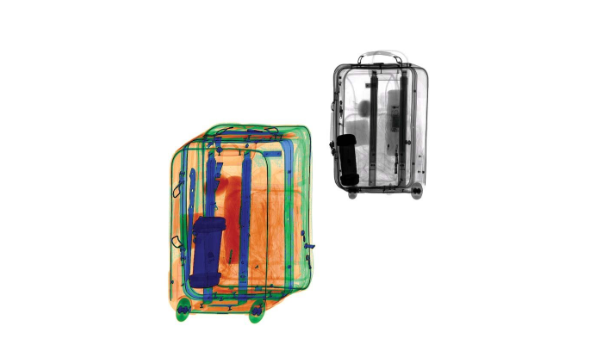
Polimek Elektronik devices employ dual-generator or dual-energy detector configurations to differentiate materials based on their atomic composition. This technology enables highly accurate classification of organic (orange), inorganic (green/blue), and dense or metallic (black) substances.
Various Tunnel Sizes:
A wide range of tunnel sizes, from small parcel screening (50×30 cm tunnel) to larger boxed and palletized loads (100×100 cm and above), ensures adaptability to diverse operational requirements. Compact tunnel systems are ideal for low-volume, high-throughput environments, while larger tunnel configurations allow bulkier items to be screened in a single pass. This flexibility enhances operational efficiency in both high-traffic access points and logistics or industrial screening applications.
Software Support and TIP (Threat Image Projection):
The integrated TIP (Threat Image Projection) function periodically displays simulated threat images on the operator’s screen to assess and improve vigilance, ensuring consistent detection performance.
Physical Principles and Operating Mechanism of X-Ray Screening Systems
X-ray baggage screening systems utilize the attenuation characteristics of X-rays to visualize the internal structure of objects (Gardt et al., 2024; Bhavana & Mohana).
At the core of the device, the X-ray tube generates high-speed electrons that are directed toward a metal target, resulting in the emission of X-ray photons (Polimek Elektronik, 2024; Udod & Nazarenko, 2022).
As these photons pass through baggage, they are absorbed or scattered depending on the material’s mass density (Bhavana & Mohana, 2024; Polimek Elektronik, 2024).
This fundamental physical principle enables the systems not only to detect shapes but also to differentiate between materials (Song et al., 2023; Udod & Nazarenko, 2022).
Dual-Energy Imaging and Material Discrimination
Modern systems scan baggage simultaneously using both low- and high-energy X-rays (Song et al., 2023; Motwane Security Systems, 2025). By analyzing the ratio between low and high-energy data, the system calculates the “Effective Atomic Number” (Zeff) of the material (Motwane Security Systems, 2025).
This calculation enables operators to visualize materials on the screen through color coding (Motwane Security Systems, 2025; CSIR Madras Complex, n.d.), allowing for rapid decision making.
- Orange (Organic Materials): Paper, food, plastics, and potentially explosive substances
- Green / Blue (Inorganic Materials): Glass, ceramics, light metals
- Black / Dark Tones (Dense Materials): Dense metals such as lead and steel
This color-coding mechanism serves as a fundamental operator support tool, enabling quick and effective threat identification.
Global Events Driving Technological Evolution
The evolution of X-ray baggage screening technologies has largely been shaped by a “shock-and-response” mechanism triggered by global terrorism incidents (International Civil Aviation Organization, 1974; Talbi et al., 2025; Transportation Security Administration, 2001).
Following the September 11 attacks, mandatory 100% baggage screening was introduced at airports (Federal Aviation Administration, 1973; Harris, 2002). This led to the standardization of screening not only cabin baggage but also all checked luggage through Explosive Detection Systems (EDS) (ICAO, 1974; Harris, 2002; Brigantic et al., n.d.).
After the 2006 transatlantic aircraft plot, technologies capable of analyzing the chemical composition of liquids began to emerge, including advanced algorithms and computed tomography (CT) systems (Vukadinovic & Anderson, 2022; TSA, n.d.).
The 2009 Christmas Day bombing attempt further accelerated the adoption of “Advanced Imaging Technologies,” which are capable of detecting non-metallic threats on passengers (Liberty Defense, 2023; Moulder, 2025).
Artificial Intelligence Integration
Artificial intelligence systems analyze X-ray images to detect weapons, knives, and explosives within seconds (Tureček et al., 2025; BARC, 2022). This technology minimizes operator errors caused by fatigue and accelerates anomaly detection (Brigantic et al., n.d.; Hättenschwiler et al., 2018).
Sustainability and the 2030 Vision
Modern X-ray systems are increasingly designed with energy efficiency and environmentally friendly materials in mind (Talbi et al., 2025; Vukadinovic & Anderson, 2022). Next-generation devices can switch to sleep mode when not in use, achieving energy savings of up to 30% (Vukadinovic & Anderson, 2022).
Within the 2030 vision supported by organizations such as International Air Transport Association walk-through security tunnels will become standard, allowing passengers to pass without stopping or removing items such as shoes and belts (Safeway Inspection System, 2025; IATA, 2026). In this process, baggage data will be integrated with facial recognition and biometric identity verification systems to enable risk-based screening (Bahic, 2025; Future Market Insights, 2025; Ken Research, n.d.).
References
Bhabha Atomic Research Centre (BARC). (2022). Automated threat recognition in X-Ray baggage scanner images.
Bahic, M. (2025). Inside the transformation of airport X-ray screening. Asadria.
Berti, A. (2020). Timeline: The history of airport body scanners. Airport Technology.
Bhavana, C., & Mohana, R. (2024). Fabrication of X-Ray machine for baggage inspection.
Brigantic, R., Willis, J., et al. (n.d.). Aviation security screening optimizer for risk and throughput.
CSIR Madras Complex. (n.d.). Dual energy X-ray image analysis technique.
Davis, B. O., Jr. (1973). The government’s response to hijacking. Villanova Law Review.
Federal Aviation Administration (FAA). (1973). Mandatory 100% passenger screening rules.
Future Market Insights. (2025). Airport Cabin Baggage Scanner Market: Global outlook 2025-2035.
Gardt, S., et al. (2024). Modeling the implementation of technology in a passenger security checkpoint.
Harris, D. (2002). Human factors in aviation security.
Hättenschwiler, N., et al. (2018). Automation in airport security X-ray screening. Applied Ergonomics.
IATA. (2026). The future of checkpoint: Digital transformation.
IATA & Airports Council International (ACI). (2026). SMART Security: A vision for 2030.
International Civil Aviation Organization (ICAO). (1974). Annex 17: Security.
Ken Research. (n.d.). Global Airport Security Market Future Outlook to 2030.
LINEV Systems. (2025). AI-powered autonomous threat detection.
Liberty Defense. (2023). HEXWAVE: Walkthrough security screening system.
McCrie, R., & Haas, D. (2018). Why airline passenger screening will be with us forever.
Motwane Security Systems. (2025). What is Zeff (Effective Atomic Number)?.
Moulder, W. (2025). Walk-through screening system enhances airport security. MIT.
Polimek Elektronik. (2024). Gelişmiş X-ray muayene sistemleri teknik incelemesi.
Ritchie, H. (2017). Airline hijackings were once common but are very rare today. Our World in Data.
Safeway Inspection System. (2025). Sustainable trends in airport security operations.
Schwaninger, A. (2005). Increasing efficiency in airport security screening.
Schwaninger, A., & Merks, S. (2019). Single-view, multi-view and 3D imaging for baggage screening.
Smith, S. W. (1992). The Secure 1000: Concept for a whole body backscatter scanner.
Song, X., et al. (2023). Research on luggage package extraction based on deep learning.
T.C. Ticaret Bakanlığı. (2023). Gümrük kapılarında teknolojik denetim strateji raporu.
TRT Haber. (2021). Aselsan’ın yerli X-Ray cihazı kullanıma alındı.
TSA. (2001). Aviation and Transportation Security Act.
TSA. (n.d.). Computed Tomography: Enhancing threat detection.
Talbi, A., et al. (2025). An overview on computer vision analysis in the airport applications. IEEE Access.
TechnoArge. (2019). Kenevir lifli kompozitlerin X-ray yalıtımında kullanımı.
Tureček, J., et al. (2025). Increasing the efficiency of airport security by AI. Transport Problems.
Udod, V., & Nazarenko, S. (2022). X-ray inspection systems with sandwich radiation detectors.
Vukadinovic, D., & Anderson, D. (2022). X-ray baggage screening and artificial intelligence. EU Publications.
X-Ray Center (XRC). (n.d.). Kurumsal tarihçe ve küresel çözümler.